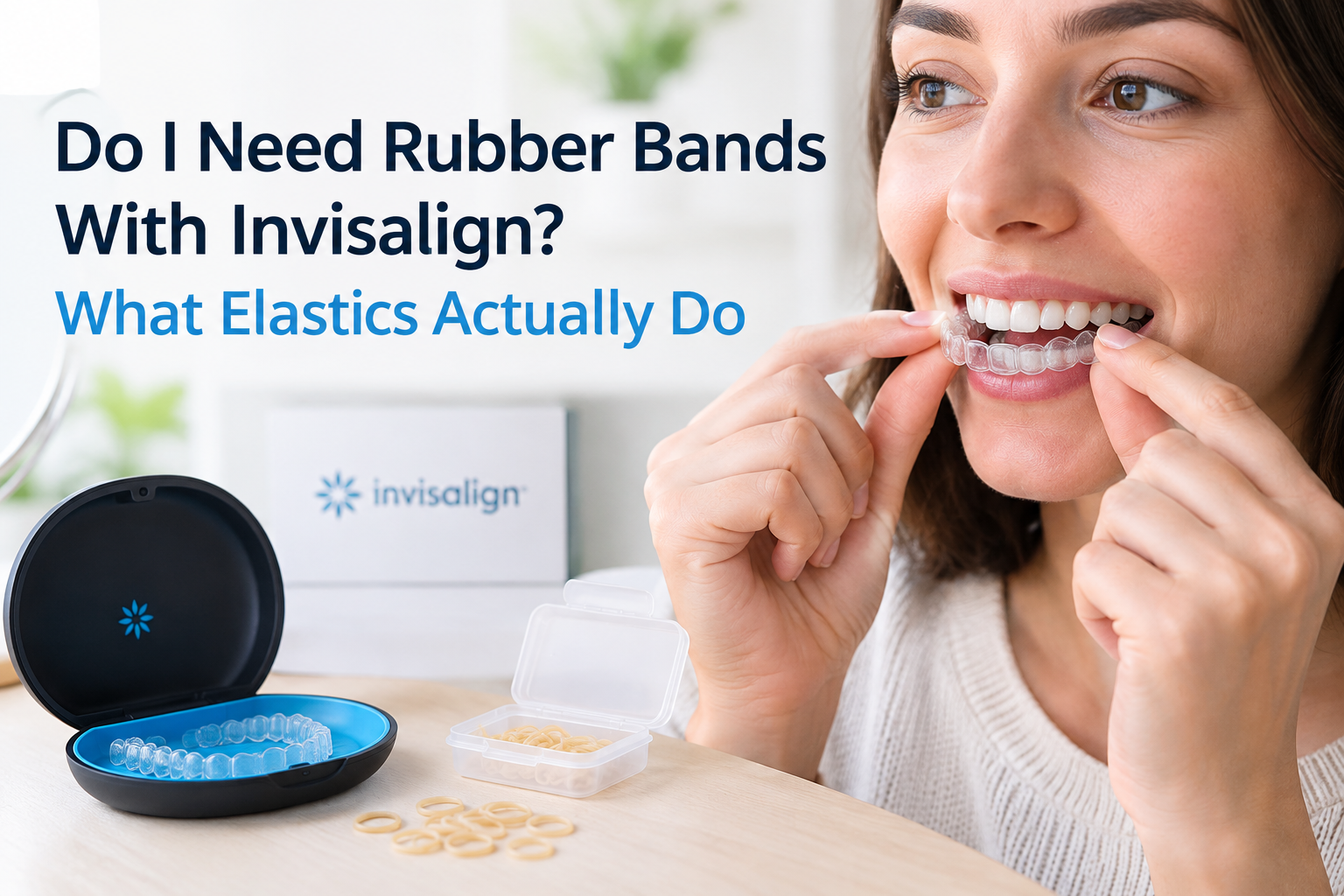
If you use clear aligners, you may wonder whether rubber bands are necessary. The answer depends on your bite, tooth movement, and personalized orthodontic treatment plan.
Not everyone undergoing Invisalign treatment needs rubber bands during their aligner journey. Some patients only require aligners, while others need additional orthodontic forces for correction.
Invisalign rubber bands, also called elastics, connect specific points between your dental arches. They provide controlled forces that may help guide certain teeth or bite relationships.
Your orthodontist may recommend elastics when treating specific alignment or bite concerns. These can include overbite, underbite, crossbite, or other treatment-specific orthodontic movements.
In general, Invisalign elastics may help:
- Apply additional directional force that clear aligners cannot provide independently.
- Support planned changes involving upper and lower teeth during orthodontic treatment.
- Help manage certain bite relationships according to your orthodontist’s treatment plan.
- Work alongside attachments, buttons, or precision cuts when clinically appropriate.
However, elastic placement and wearing schedules are different for every patient’s treatment. Never copy another person’s rubber-band pattern or change your prescribed configuration yourself.
Your orthodontist determines whether you need elastics, where they attach, and duration. Following those instructions consistently helps treatment progress according to the planned orthodontic movements.
What Are Invisalign Rubber Bands?
Invisalign rubber bands are small orthodontic elastics used alongside clear aligner treatment. They create additional forces between selected teeth or areas of your dental arches.
These elastics usually connect designated attachment points on the upper and lower teeth. Your orthodontist chooses their placement according to your specific tooth and bite movements.
Rubber bands may become part of treatment when aligners need additional mechanical assistance. However, their exact purpose varies considerably between individual orthodontic treatment plans.
Invisalign Rubber Bands vs. Regular Rubber Bands
Orthodontic elastics are specifically manufactured for controlled use during orthodontic treatment. Their size, strength, and force characteristics can differ according to treatment requirements.
Regular household rubber bands should never replace prescribed Invisalign elastics. They are not designed to deliver predictable orthodontic forces safely to your teeth.
Use only the elastic type and size recommended by your treating orthodontist.
Rubber Bands vs. Invisalign Attachments
Attachments and rubber bands perform different roles during clear aligner treatment. Attachments are small tooth-colored shapes bonded temporarily onto selected tooth surfaces.
Aligners grip these attachments to improve control during certain planned tooth movements. Elastics create additional forces between prescribed attachment points elsewhere within the mouth.
Some treatment plans use attachments without requiring any rubber bands with Invisalign. Others may combine attachments and elastics when additional orthodontic mechanics become necessary.
What Are Buttons and Precision Cuts?
Buttons are small attachment points that can help secure orthodontic elastics. Depending on treatment design, they may be bonded directly onto selected teeth.
Precision cuts are small openings or hooks incorporated into certain clear aligners. These features provide another location where prescribed elastics can sometimes be connected.
Your specific aligner design determines which attachment method your orthodontist recommends.
How Elastics Connect the Upper and Lower Teeth
Orthodontic elastics can connect selected points between your upper and lower dental arches. This connection creates directional forces according to the planned orthodontic movement.
The elastic pattern may look different depending on the bite relationship being treated. That is why another patient’s Invisalign bands should never guide your configuration.
Correct placement matters because changing attachment points changes the direction of applied force. Always follow the exact pattern demonstrated by your orthodontist or dental treatment team.
Do I Need Rubber Bands With Invisalighn?
No, not every patient needs rubber bands with Invisalign during clear aligner treatment. Your orthodontist recommends elastics only when they support specific planned orthodontic movements.
Some treatment plans focus mainly on repositioning teeth within the individual dental arches. Other cases may require additional forces affecting how upper and lower teeth relate.
Your need for elastics may depend on factors including:
- The type and severity of your existing bite alignment problem.
- Which teeth require movement during different stages of your treatment.
- How your upper and lower dental arches currently fit together.
- Whether aligners alone can provide the planned orthodontic forces effectively.
- Your orthodontist’s treatment strategy and response during scheduled progress evaluations.
Therefore, needing elastics does not necessarily mean your Invisalign case is unusually complicated.
Does Everyone With Invisalign Need Rubber Bands?
No, Invisalign elastics are not a standard requirement for every patient. Many people can complete treatment without wearing orthodontic rubber bands at all.
Patients primarily addressing certain spacing or alignment concerns may not require elastics. However, individual treatment decisions depend on much more than the visible problem.
Your orthodontist evaluates your teeth, bite, jaw relationship, and planned movements before deciding.
Why Do Some Patients Need Elastics?
Clear aligners apply controlled forces directly to teeth throughout each treatment stage. However, certain movements may benefit from additional forces provided by orthodontic elastics.
Rubber bands can connect different areas within the upper and lower arches. This arrangement can help influence specific bite relationships according to treatment goals.
Common reasons an orthodontist may prescribe elastics include:
- Supporting correction of certain overbite or underbite relationships during treatment.
- Assisting planned movements involving how upper and lower teeth fit together.
- Providing additional directional force for specific orthodontic movements when required.
- Supporting bite-related adjustments that aligners cannot accomplish predictably by themselves.
These are general examples rather than instructions for individual treatment.
How Does Your Orthodontist Decide?
Your orthodontist begins by evaluating tooth positions and how your bite fits together. Digital scans, photographs, examinations, and sometimes dental imaging support treatment planning.
The planned movements are then divided across different stages of aligner treatment. Elastics may be incorporated when additional force becomes useful during particular stages.
Your orthodontist may also adjust the plan according to your treatment response.
Can Invisalign Work Without Rubber Bands?
Yes, Invisalign treatment can work without rubber bands for many suitable patients. Whether elastics are necessary depends on the movements included within your treatment plan.
Not receiving elastics does not mean your treatment is incomplete or less effective. Likewise, receiving them does not automatically indicate a severe orthodontic problem.
The important factor is following the treatment plan designed for your individual needs. Never start wearing orthodontic elastics simply because another Invisalign patient uses them.
What Do Rubber Bands Do for Invisalign?
The main Invisalign rubber bands purpose is providing additional controlled orthodontic force when needed. Clear aligners move teeth, while elastics can support certain bite-related treatment goals.
Rubber bands connect prescribed points between teeth or aligner attachment areas. This connection creates force in directions selected by your treating orthodontist.
Their exact function depends on your bite, treatment stage, and planned tooth movements.
Help Guide Bite Correction
Your bite describes how upper and lower teeth relate when closing together. Certain bite problems may require movements involving both dental arches during treatment.
Orthodontic elastics can support these planned changes by applying additional directional forces. They may be prescribed for certain overbite, underbite, crossbite, or other bite relationships.
However, the same elastic configuration cannot correct every type of malocclusion.
Create Additional Directional Force
Clear aligners generate forces by fitting closely around your teeth and attachments. Elastics can introduce another force direction when your treatment mechanics require additional assistance.
Think of the aligners and elastics as different components within one treatment system. Each component performs a specific role determined during your orthodontic treatment planning.
This explains what rubber bands do with Invisalign without assuming everyone needs them.
Connect the Upper and Lower Dental Arches
Some orthodontic movements involve relationships between the upper and lower dental arches. Elastics can connect selected points across these arches according to treatment requirements.
This connection can influence how forces are distributed during specific treatment stages. Your orthodontist determines which attachment points create the intended direction of force.
Changing those points independently could produce forces different from those originally prescribed.
Support Specific Orthodontic Movements
Invisalign elastics may support movements that require additional anchorage or directional control. Their role can change as your teeth progress through different aligner stages.
Your orthodontist may use elastics to support:
- Planned changes involving upper and lower tooth relationships during bite correction.
- Specific movements requiring forces beyond those produced by aligners alone.
- Greater control during selected stages of your personalized orthodontic treatment.
- Treatment mechanics involving attachments, buttons, hooks, or precision-cut aligners.
The exact benefits depend on your diagnosis and individualized treatment objectives.
Why Aren’t Clear Aligners Always Enough?
Clear aligners can manage many tooth movements through carefully planned sequential changes. However, orthodontic treatment involves different movement types with varying biomechanical requirements.
Some movements may benefit from attachments, elastics, or other orthodontic auxiliaries. These additions do not mean your aligners have failed or stopped working.
Instead, they become tools supporting the overall treatment strategy designed by your orthodontist.
How Do Rubber Bands Work With Invisalign?
Understanding how rubber bands work with Invisalign starts with basic orthodontic force. Teeth can gradually move when carefully controlled forces are applied over appropriate periods.
Clear aligners provide forces through their close fit around teeth and attachments. Elastics add another force system between specific points selected by your orthodontist.
Together, these components can support the movements planned throughout your treatment.
How Orthodontic Elastics Apply Force
An orthodontic elastic stretches when connected between its prescribed attachment points. The stretched elastic creates tension that produces force in a particular direction.
That force can contribute to planned changes involving teeth or bite relationships. Your orthodontist selects elastic strength and placement according to your treatment requirements.
Using different elastics could change the amount or direction of applied force.
Why Does Elastic Direction Matter?
Orthodontic force is directional, meaning placement influences how teeth respond during treatment. Connecting an elastic differently may create a completely different mechanical effect.
For example, treatment approaches for different bite relationships require different force directions. This explains why patients should never copy another person’s elastic configuration.
Always use the hooks or buttons specifically identified by your orthodontic provider.
Why Are Attachment Points Different Between Patients?
Every patient has different tooth positions, bite relationships, and treatment objectives. Therefore, Invisalign rubber band attachment points are not standardized across all treatments.
One patient may have buttons bonded directly onto selected teeth for elastics. Another may use precision cuts incorporated into specific upper or lower aligners.
Some patients may use both methods during different stages of treatment.
What Happens When You Wear Elastics Consistently?
Orthodontic treatment depends partly on applying planned forces consistently over appropriate periods. Wearing elastics as prescribed helps maintain the force system designed for treatment.
Frequently forgetting them may reduce consistency within the prescribed treatment mechanics. However, never compensate by doubling bands or changing your wearing schedule independently.
If you miss significant wear time, contact your orthodontist for appropriate guidance.
Do Stronger Rubber Bands Work Faster?
Stronger elastics do not automatically produce faster or better orthodontic treatment results. Excessive or incorrectly directed force can interfere with the intended treatment mechanics.
Only use the elastic size and strength prescribed by your orthodontist. Never double rubber bands on Invisalign unless your orthodontist specifically instructs you.
More force is not necessarily better when moving teeth safely and predictably.
Invisalign Rubber Bands for Different Bite Problems
Orthodontists may prescribe elastics when treatment involves certain relationships between dental arches. However, having a particular bite problem does not automatically mean you need elastics.
Your orthodontist considers severity, tooth positions, jaw relationships, and planned movements before prescribing them. The required elastic direction can also differ significantly between individual treatment plans.
Invisalign Rubber Bands for Overbite
An overbite describes excessive vertical overlap between upper and lower front teeth. It should not be confused with overjet, which describes horizontal tooth relationships.
Invisalign rubber bands for overbite may support certain planned bite-related movements during treatment. Their specific role depends on what contributes to the patient’s individual overbite.
Treatment may involve aligners, attachments, elastics, or other orthodontic strategies working together. Therefore, online elastic diagrams should never replace instructions from your treating orthodontist.
Invisalign Rubber Bands for Underbite
An underbite occurs when lower teeth sit forward relative to upper teeth. Its causes and severity can differ considerably between individual orthodontic patients.
Invisalign rubber bands for underbite may support selected treatment mechanics in appropriate cases. However, not every underbite can be managed through identical clear-aligner treatment approaches.
Your orthodontist evaluates both dental and jaw relationships before recommending appropriate treatment options.
Invisalign Elastics for Crossbite
A crossbite occurs when certain upper teeth bite inside corresponding lower teeth. Crossbites can involve individual teeth or larger sections within the dental arches.
Elastics may sometimes support movements included within a personalized crossbite treatment plan. Their direction and attachment points depend entirely on the required orthodontic correction.
Never reposition elastics because another patient’s crossbite appears similar to yours.
Can Elastics Be Used for an Open Bite?
An open bite occurs when certain upper and lower teeth remain separated during closure. Different factors can contribute to open bites, making individualized assessment particularly important.
Some clear-aligner treatment plans may incorporate elastics for specific open-bite movements. Other cases may require different orthodontic strategies based on their underlying characteristics.
Treatment recommendations should follow a complete orthodontic examination rather than appearance alone.
Elastics for Other Tooth and Bite Movements
Orthodontic elastics are not limited exclusively to common bite labels like overbite. They may support other treatment-specific movements when additional force or anchorage becomes necessary.
Depending on the treatment plan, elastics may help:
- Coordinate relationships between selected upper and lower teeth during treatment.
- Support particular tooth movements requiring additional directional force or anchorage.
- Work alongside attachments or buttons during specific clear-aligner treatment stages.
- Assist bite refinement when your orthodontist determines additional mechanics are appropriate.
These Invisalign rubber bands benefits depend on accurate diagnosis and individualized treatment planning.
When Do You Start Wearing Rubber Bands for Invisalign?
There is no universal treatment stage when every patient begins wearing orthodontic elastics. Your starting time depends on the movements planned throughout your clear-aligner treatment.
Some patients may begin Invisalign elastics relatively early within their treatment plan. Others may receive elastics later after certain teeth reach planned positions.
Your orthodontist determines the appropriate timing after reviewing your individual treatment needs.
Can Elastics Start With Your First Aligners?
Some treatment plans may include rubber bands from the earliest aligner stages. This approach may be appropriate when additional forces are required from treatment beginning.
However, starting immediately does not mean your orthodontic case is necessarily more severe. The timing simply reflects how your orthodontist has designed your treatment mechanics.
Follow the provided instructions rather than comparing your schedule with another patient’s experience.
Can Rubber Bands Be Added Later?
Yes, rubber bands with Invisalign may sometimes become necessary during later treatment stages. Your orthodontist may introduce them when specific movements or bite adjustments become appropriate.
Treatment plans can also change according to how your teeth respond. Regular appointments allow your orthodontist to monitor progress and make necessary adjustments.
Receiving elastics later does not automatically mean your original treatment plan failed.
Why Does Treatment Timing Vary?
Clear-aligner treatment involves a planned sequence of tooth movements across multiple stages. Different movements may require different combinations of aligners, attachments, buttons, and elastics.
Several factors can influence when elastics become part of treatment:
- Your existing tooth positions and relationship between both dental arches.
- The specific bite problem being addressed within your orthodontic treatment plan.
- Which tooth movements must occur before additional elastic forces become useful.
- Your response to previous aligners and treatment progress during scheduled evaluations.
- Whether refinement stages require additional adjustments to your bite or alignment.
This explains why there is no standard answer for every Invisalign patient.
Follow Your Orthodontist’s Treatment Plan
Never begin wearing Invisalign rubber bands before your orthodontist instructs you. Likewise, do not stop using them simply because your teeth appear straighter.
Visible alignment does not always show whether planned bite movements are complete. Your orthodontist evaluates factors that cannot be reliably assessed through appearance alone.
If you forget when to begin elastics, contact your orthodontic office for instructions.
How to Put Rubber Bands on Invisalign
Learning how to put rubber bands on Invisalign can feel challenging initially. However, the process usually becomes easier after practicing your prescribed attachment pattern.
Your orthodontist should demonstrate exactly where each elastic connects during your appointment. Follow that configuration because attachment points and elastic strengths vary between treatment plans.
Never use an online diagram to determine where your elastics should connect.
1. Follow Your Prescribed Elastic Pattern
Before attaching anything, confirm which hooks or buttons your orthodontist identified. Some patients use different configurations on each side depending on their treatment needs.
Check your written instructions whenever you are uncertain about the prescribed pattern. Contact your orthodontic office when those instructions remain unclear.
2. Wash and Dry Your Hands
Clean hands make handling small Invisalign elastic bands easier and more hygienic. Wash your hands thoroughly before touching your aligners, elastics, buttons, or mouth.
Drying your fingers can also improve your grip on small orthodontic elastics.
3. Identify the Correct Hooks or Buttons
Look for the specific attachment points demonstrated by your orthodontic treatment team. These may include buttons bonded onto teeth or precision cuts within aligners.
Do not assume similar-looking hooks serve the same orthodontic purpose. Connecting an elastic incorrectly can change the direction of the intended force.
4. Attach the Elastic as Demonstrated
Your orthodontist may recommend attaching elastics before or after inserting your aligners. Follow their technique because aligner designs and attachment systems can differ between patients.
Generally, carefully stretch the prescribed elastic between its designated attachment points. Make sure it remains securely connected without twisting or attaching elsewhere accidentally.
Avoid stretching the band unnecessarily beyond what correct placement requires.
5. Check That Your Aligners Remain Seated
After attaching your elastics, check whether each aligner remains properly positioned. Your trays should continue fitting according to the instructions provided by your orthodontist.
If an aligner repeatedly lifts or becomes displaced after attaching elastics, seek guidance. Do not modify hooks, buttons, or aligners yourself to improve their fit.
Tips for Handling Invisalign Elastics
Small rubber bands can initially feel difficult to grip and position accurately. These simple habits may make your prescribed routine more manageable:
- Attach elastics in front of a mirror while learning your configuration.
- Keep spare prescribed bands available when traveling, working, or attending school.
- Replace dropped or contaminated elastics rather than placing them inside your mouth.
- Store your elastic package somewhere clean, dry, and easily accessible.
- Follow the same attachment sequence each time to build a consistent routine.
Some patients may receive a small elastic-placement tool from their orthodontic provider.
What If You Cannot Attach Your Elastics?
Do not repeatedly force an elastic when its attachment point feels inaccessible. A broken button, damaged hook, or aligner problem may require professional attention.
Contact your orthodontist if you cannot reproduce the demonstrated elastic configuration. They can confirm how to attach Invisalign rubber bands according to your treatment plan.
How Long Should You Wear Invisalign Rubber Bands Each Day?
Your orthodontist determines how long Invisalign rubber bands should remain attached each day. Some patients receive longer wear schedules, while others follow more limited instructions.
Wear time depends on the movements being planned and your current treatment stage. Therefore, another Invisalign patient’s schedule should never replace your orthodontist’s recommendations.
Consistent wear matters because elastics work through controlled orthodontic forces over time.
Follow Your Orthodontist’s Prescribed Wear Schedule
Your treatment team should explain when elastics should be worn and removed. Follow those directions consistently unless your orthodontist later modifies your treatment plan.
Do not independently increase wear time because you want faster orthodontic results. More elastic wear does not automatically produce safer or quicker tooth movement.
Likewise, reducing prescribed wear may interfere with the planned orthodontic force pattern.
Do You Remove Elastics When Eating?
Whether elastics remain attached while eating depends on your orthodontist’s specific instructions. Clear aligners themselves are generally removed for meals unless your provider advises differently.
When removing your aligners, follow the instructions provided for your Invisalign elastics. Replace elastics as directed after eating and completing your recommended oral hygiene routine.
Avoid guessing when your treatment team has provided different instructions.
Should Elastics Be Removed When Brushing?
You will generally need clear access to your teeth during brushing and flossing. This usually requires removing aligners and managing elastics according to your prescribed routine.
After cleaning your teeth, reinstall your aligners as your treatment plan requires. Then attach fresh or prescribed elastics according to your orthodontist’s replacement instructions.
Good oral hygiene remains important throughout clear-aligner treatment.
What Happens If You Forget Your Rubber Bands?
Missing elastic wear occasionally can happen, especially while adapting to a new routine. Do not panic or attempt to compensate using extra rubber bands on Invisalign.
Instead:
- Resume your prescribed schedule unless your orthodontist has provided different instructions.
- Never double the elastics to compensate for previously missed wearing time.
- Avoid switching to stronger bands without direct instructions from your orthodontist.
- Contact your treatment team when you miss substantial or repeated wear time.
Your orthodontist can determine whether any treatment adjustment becomes necessary.
Can You Wear Invisalign Elastics Too Much?
Yes, wearing elastics differently from your prescription can alter intended orthodontic forces. This includes extending wear time or adding additional bands without professional guidance.
Orthodontic treatment depends on controlled force rather than simply maximizing elastic tension. Follow your prescribed schedule even when your teeth or bite appear improved.
Do You Wear Invisalign Rubber Bands to Sleep?
Many patients ask, “Do I wear my rubber bands to sleep?” The answer depends entirely on the wearing schedule prescribed by your orthodontist.
Patients instructed to wear elastics full-time will commonly continue wearing them overnight. However, some treatment plans may use different schedules based on specific orthodontic objectives.
Never assume nighttime wear is required unless your treatment team confirms it.
Can You Sleep With Invisalign Elastics?
Orthodontic elastics are commonly designed for extended wear when clinically prescribed. This can include sleeping hours when nighttime wear forms part of treatment.
Before bedtime, make sure your aligners and elastics remain correctly positioned. Follow your usual brushing and aligner-cleaning routine before replacing prescribed elastics.
Do not modify their attachment pattern specifically for sleeping.
Why Might Nighttime Wear Be Recommended?
Orthodontic elastics work by delivering controlled force between their prescribed attachment points. Consistent wear may help maintain that planned force during designated treatment periods.
Removing elastics every night could interrupt prescribed wear when overnight use is required. However, only your orthodontist can determine whether nighttime wear benefits your specific treatment.
Your individual schedule takes priority over general advice found online.
What If an Elastic Breaks During the Night?
An orthodontic elastic can occasionally break or become detached while you are sleeping. Discovering a broken band after waking does not usually require improvising your treatment.
Replace it according to your orthodontist’s normal instructions when appropriate. Contact your treatment team when bands repeatedly break or attachment points appear damaged.
Repeated breakage may indicate an issue requiring professional evaluation.
Should You Double Elastics After Missing Nighttime Wear?
Never double Invisalign rubber bands unless your orthodontist specifically instructs you. Adding another elastic changes the force applied between your attachment points.
Extra force does not automatically compensate for previously missed wearing time. It may instead alter the carefully planned mechanics of your orthodontic treatment.
Resume your prescribed routine and contact your orthodontist when substantial wear was missed.
Making Nighttime Elastic Wear Easier
A consistent evening routine can make prescribed nighttime elastic wear easier to remember. Keep approved elastics near your dental-care supplies without exposing them to contamination.
Before sleeping:
- Brush and floss according to your usual oral hygiene routine.
- Clean your clear aligners using your provider’s recommended cleaning method.
- Insert your trays properly and confirm they remain completely seated.
- Attach fresh elastics when your orthodontist’s replacement instructions require them.
- Check each elastic against the attachment pattern demonstrated during your appointment.
Consistency can help prescribed elastic wear become part of your normal routine.
How Often Should You Change Invisalign Elastics?
Invisalign elastics gradually lose some tension after being stretched and worn. Replacing them as directed helps maintain the force pattern planned by your orthodontist.
There is no universal replacement schedule suitable for every Invisalign treatment plan. Your orthodontist should explain when to replace elastics and which type to use.
Always follow those instructions rather than creating your own replacement schedule.
Why Do Orthodontic Elastics Lose Force?
Orthodontic rubber bands remain stretched while connected between their prescribed attachment points. Over time, their mechanical properties can change during normal wear inside your mouth.
Saliva, stretching, and repeated use may also affect how elastics perform. This explains why orthodontists commonly provide specific replacement instructions during clear-aligner treatment.
Fresh bands should still match the exact type originally prescribed.
Should You Reuse Invisalign Rubber Bands?
Avoid repeatedly reusing old rubber bands with Invisalign unless specifically instructed otherwise. Previously worn elastics may not provide the same force as fresh ones.
Never substitute a different size because your original supply becomes unavailable. Elastic packages can contain bands with different dimensions and force characteristics.
Using the wrong product may change the intended orthodontic mechanics.
Should You Carry Spare Elastics?
Keeping spare prescribed elastics nearby can make consistent wear easier during busy days. This becomes particularly useful when bands break, fall, or require scheduled replacement.
Consider keeping approved supplies in:
- Your aligner case or another clean container recommended by your provider.
- A work, school, or travel bag used throughout your normal day.
- Your regular oral-care area for convenient morning and nighttime replacement.
- Another clean location where the original elastic package remains clearly identifiable.
Keep elastics away from small children and household pets.
What Should You Do If an Elastic Breaks?
A broken elastic should generally be replaced according to your treatment instructions. Do not compensate by adding additional bands to the remaining attachment points.
If bands frequently snap, check whether your buttons or hooks appear damaged. Contact your orthodontist when repeated breakage continues despite following the demonstrated attachment method.
What If You Run Out of Invisalign Elastics?
Contact your orthodontic office when your supply becomes low or completely unavailable. They can provide or recommend the exact elastic type required for your treatment.
Do not replace prescribed Invisalign rubber bands with household or unapproved orthodontic bands. Similar-looking products can deliver different forces despite appearing nearly identical.
Keep the original packaging when possible because it identifies your prescribed elastic type.
What Do Invisalign Rubber Bands Feel Like?
Starting Invisalign rubber bands can make your mouth feel different during early wear. Some patients notice pressure around teeth connected by the prescribed orthodontic elastics.
Your cheeks and lips may also need time adjusting to buttons or hooks. Individual experiences vary according to elastic strength, attachment locations, and planned tooth movements.
Is Pressure From Invisalign Elastics Normal?
Mild pressure can occur when orthodontic elastics begin applying their prescribed forces. You may notice this sensation more after attaching fresh bands or changing aligners.
The pressure should not encourage you to alter the prescribed elastic pattern. Removing or repositioning bands independently may interfere with your planned treatment mechanics.
Contact your orthodontist when pressure becomes unusually intense or concerning.
Do Invisalign Elastics Hurt?
Some people experience temporary tenderness while adjusting to new orthodontic forces. However, significant or worsening pain should not simply be considered a normal requirement.
Discomfort can also originate from a button, hook, aligner edge, or irritated tissue. Identifying the source helps your orthodontic team recommend the appropriate next step.
Do not use additional rubber bands with Invisalign hoping to accelerate adaptation.
How Long Does Initial Discomfort Last?
There is no exact adjustment period that applies to every Invisalign patient. Mild tenderness may improve as your mouth adapts to the prescribed treatment mechanics.
Your experience can vary when elastic configurations or aligner stages change. Persistent discomfort deserves attention when it interferes with eating, sleeping, or normal activities.
Avoid changing your elastic schedule without discussing ongoing discomfort with your orthodontist.
When Should You Contact Your Orthodontist?
Certain symptoms deserve professional guidance instead of continued self-management. Contact your orthodontic provider when you experience:
- Severe or increasing pain that does not improve as expected.
- Persistent sores caused by buttons, hooks, elastics, or aligner edges.
- Swelling, bleeding, or tissue injuries developing around elastic attachment points.
- A button or hook becoming loose, damaged, or completely detached.
- Aligners repeatedly lifting after your prescribed elastics are correctly attached.
- New symptoms that make normal eating, sleeping, or oral hygiene difficult.
Seek urgent medical or dental attention for severe swelling or breathing difficulties.
Do Not Adjust Treatment Because of Discomfort
Changing elastic strength or placement yourself can alter the intended orthodontic force. Instead, explain your symptoms clearly when contacting your orthodontic treatment team.
Your provider can determine whether your Invisalign elastic bands require adjustment or replacement. They can also check whether another treatment component is causing the discomfort.
Invisalign With Rubber Bands: Before and After Expectations
Searching for Invisalign with rubber bands before and after photos can help visualize treatment possibilities. However, another patient’s results cannot reliably predict how your teeth will respond.
Invisalign elastics are prescribed to support specific movements within an individualized orthodontic plan. Your final outcome depends on your starting bite, treatment goals, anatomy, and treatment response.
What Changes Can Invisalign Rubber Bands Support?
Depending on your treatment plan, elastics may help improve relationships between upper and lower teeth. They can provide directional forces that complement movements created by your clear aligners.
Your orthodontist may prescribe elastics to support:
- Planned changes in how the upper and lower dental arches relate.
- Bite correction when additional interarch forces are clinically appropriate.
- Specific tooth movements requiring assistance beyond the aligners alone.
- Coordination between teeth as treatment progresses through different aligner stages.
- Refinements needed to improve the planned final bite relationship.
The exact purpose should be explained by your orthodontic treatment provider.
Will Invisalign Rubber Bands Change Your Bite?
They can contribute to bite changes when incorporated into an appropriate treatment plan. However, Invisalign rubber bands do not work independently from the rest of treatment.
Aligners, attachments, buttons, elastic forces, and treatment sequencing may work together. The combination used depends on your orthodontic diagnosis and treatment objectives.
For example, elastics may support treatment for certain overbite or underbite patterns. That does not mean every patient with these conditions requires the same approach.
Why Before-and-After Results Differ Between Patients
Two people with similar-looking smiles can have very different orthodontic needs. Their underlying tooth positions, jaw relationships, and treatment goals may not be identical.
Results can also be influenced by factors such as:
- The type and complexity of the original bite problem.
- Which tooth movements are required during clear-aligner treatment.
- How consistently aligners and prescribed elastics are worn.
- Individual biological responses to controlled orthodontic forces.
- Whether additional refinement or treatment adjustments become necessary.
This is why online photographs should be viewed as examples, not predictions.
How Important Is Consistent Elastic Wear?
Following your prescribed schedule helps maintain the orthodontic forces planned by your provider. Inconsistent wear may reduce how predictably those mechanics contribute to treatment.
However, wearing extra bands or increasing tension is not a shortcut. More force does not guarantee faster or better results.
Use only the elastic type, placement, and schedule prescribed for your case.
When Will You Notice Results?
Orthodontic changes occur gradually, and visible progress varies between patients. Some bite changes may also be less obvious than improvements in tooth alignment.
Your orthodontist can evaluate progress more accurately during scheduled treatment reviews. They may assess aligner fit, tooth positions, bite relationships, and overall treatment tracking.
For meaningful comparisons, use your own treatment records rather than another patient’s photographs.
Benefits of Invisalign Rubber Bands
The main Invisalign rubber bands benefits come from providing additional orthodontic forces when aligners alone may not create every planned movement.
Elastics can work alongside aligner trays, attachments, buttons, and precision cuts. Together, these components help your orthodontist manage specific tooth and bite relationships.
However, elastics are beneficial only when they are appropriate for your individual treatment plan.
Provide Additional Directional Force
Clear aligners apply controlled forces to move teeth toward planned positions. Certain movements may benefit from forces acting between the upper and lower dental arches.
Invisalign elastics can provide this additional direction when clinically appropriate. Their attachment pattern determines how those forces interact with your teeth and aligners.
This is why elastic placement must follow your orthodontist’s instructions precisely.
Support Planned Bite Correction
Straight teeth and a well-coordinated bite are related but different treatment objectives. Some patients require additional mechanics to improve how their upper and lower teeth meet.
Depending on the diagnosis, elastics may support treatment involving certain:
- Overbite or overjet relationships.
- Underbite patterns.
- Crossbite relationships.
- Open-bite patterns.
- Other upper-to-lower dental arch discrepancies.
Not every case within these categories requires rubber bands with Invisalign.
Complement Clear Aligner Treatment
Aligners remain the primary treatment system for many Invisalign patients. Elastics serve as an orthodontic auxiliary when additional mechanics are required.
They may work with attachments or buttons to help deliver planned forces. This allows the orthodontist to combine different biomechanical tools within one treatment strategy.
Help Coordinate the Upper and Lower Dental Arches
Orthodontic treatment may involve more than moving individual teeth into straighter positions. Your provider may also need to coordinate how both dental arches function together.
Elastics can help influence these relationships through prescribed interarch forces. Their role depends on your bite, tooth positions, and treatment objectives.
Allow More Individualized Treatment Mechanics
One important Invisalign elastics purpose is supporting treatment customization. Different patients can require different elastic strengths, directions, attachment points, and wearing schedules.
This flexibility allows orthodontists to design mechanics around individual clinical needs. It does not mean stronger or more complicated elastic patterns produce better results.
Support Treatment Progress When Worn as Prescribed
The potential benefits of elastics depend partly on following your prescribed schedule. Consistent use helps maintain the treatment mechanics your orthodontist designed.
For the best chance of following the plan accurately:
- Use only the elastic type provided or approved by your orthodontist.
- Connect each band to the exact prescribed attachment points.
- Follow your recommended wear and replacement schedule.
- Report broken buttons, damaged hooks, or repeated aligner-fitting problems.
- Never double elastics or independently change their strength or configuration.
Invisalign rubber bands are not necessary for everyone. When prescribed appropriately, however, they can provide useful forces supporting specific orthodontic goals.
Common Mistakes With Invisalign Rubber Bands
Using Invisalign rubber bands correctly is just as important as wearing them consistently. Small changes in placement, strength, or wear patterns can alter their intended force.
Your orthodontist selects elastics according to your individual treatment mechanics. Avoid making adjustments based on another patient’s routine or advice found online.
Here are several common mistakes to avoid during treatment.
Using the Wrong Elastic Size or Strength
Orthodontic elastics are available in different sizes and force levels. Similar-looking bands are not necessarily interchangeable.
Always use the exact elastic type provided or approved by your orthodontist. If you run out, contact your treatment team rather than purchasing substitutes independently.
Connecting Rubber Bands to the Wrong Teeth
Elastic attachment points determine the direction of the orthodontic force being applied. Connecting them incorrectly may change the intended treatment mechanics.
Follow the pattern demonstrated by your orthodontist. If you cannot remember it, ask your provider before continuing.
Doubling Invisalign Elastics
Never double your Invisalign elastics to compensate for missed wearing time. Two bands can create a different force than your treatment plan intended.
More force does not necessarily move teeth faster or improve results. Resume your prescribed schedule and seek guidance after significant missed wear.
Changing the Elastic Pattern Yourself
Do not move bands to different hooks because another configuration feels more comfortable. Even a small change can affect the direction of force.
Your prescribed configuration was selected for specific orthodontic objectives. Any adjustment should therefore come from your orthodontic provider.
Reusing Old Rubber Bands
Previously worn elastics may not behave like fresh bands after extended stretching. Follow your orthodontist’s replacement instructions instead of repeatedly reusing old elastics.
Keep spare prescribed bands available when away from home.
Wearing Elastics Inconsistently
Frequently forgetting rubber bands with Invisalign may interrupt the mechanics your orthodontist planned. Developing a predictable routine can make prescribed wear easier to maintain.
Consider linking elastic replacement with established habits such as your oral-care routine.
Stopping Because Your Bite Looks Better
Visible improvement does not necessarily mean the planned orthodontic movement is complete. Some changes require professional assessment rather than visual judgment alone.
Continue your prescribed elastics until your orthodontist changes or ends the instructions.
Using Household Rubber Bands
Never place ordinary household rubber bands around your teeth or Invisalign attachments. They are not substitutes for orthodontic elastics prescribed for controlled tooth movement.
Household bands can apply unpredictable forces and may damage oral tissues or teeth.
Copying Another Patient’s Invisalign Elastic Pattern
Photos and videos can show how rubber bands on Invisalign appear. They should never be used as personalized attachment instructions.
Another patient may have a different bite problem, force requirement, or treatment stage. Their elastic configuration may therefore be inappropriate for your teeth.
When uncertain about placement, strength, or wear time, contact your orthodontist rather than experimenting.
Invisalign Rubber Bands vs. Braces Rubber Bands
Invisalign rubber bands and braces elastics serve similar orthodontic purposes in many treatment plans. Both can apply controlled forces between selected teeth or areas of the dental arches.
The major difference involves how those elastics connect to the orthodontic appliance. Traditional braces use brackets and hooks, while Invisalign treatment may use buttons or precision cuts.
Despite these differences, both require individualized instructions from an orthodontic professional.
How Are Invisalign and Braces Elastics Similar?
Orthodontic elastics can complement the primary appliance used to move your teeth. Their purpose is not simply to make teeth appear straighter.
Depending on the treatment plan, both types may help:
- Apply additional directional forces during orthodontic treatment.
- Support specific upper-to-lower dental arch relationships.
- Assist with certain bite corrections when clinically appropriate.
- Work alongside the primary appliance to achieve planned movements.
- Provide forces that the appliance alone may not efficiently deliver.
In both systems, elastic strength, placement, and wearing schedules can vary significantly.
How Are Invisalign Rubber Bands Different?
Traditional braces provide fixed brackets that can serve as attachment points for elastics. These brackets remain bonded to the teeth throughout relevant treatment stages.
With Invisalign, elastic attachment may involve precision cuts, hooks, or bonded buttons. Their design and location depend on the patient’s customized aligner treatment plan.
The aligner trays must also remain properly seated while prescribed elastics are being used.
Are Invisalign Elastics the Same as Attachments?
No. Invisalign attachments and orthodontic elastics perform different functions.
Attachments are small shapes bonded to selected teeth during clear-aligner treatment. They can help aligners grip teeth and deliver particular planned movements.
Invisalign elastics, meanwhile, stretch between prescribed attachment points to create additional forces. Some treatment plans use both components together.
Does Everyone With Braces Need Rubber Bands?
No. Just as not every Invisalign patient needs elastics, not everyone with braces needs rubber bands.
The need depends on the orthodontic diagnosis and movements required during treatment. Some patients may need elastics only during particular stages, while others may not require them.
Having braces or clear aligners does not automatically determine whether elastics are necessary.
Are Braces Elastics Interchangeable With Invisalign Elastics?
Do not substitute orthodontic bands without approval from your treatment provider. Elastics can differ in diameter, material characteristics, and force.
Even when two packages appear similar, they may not match your prescription. Use only the type specifically provided or recommended by your orthodontist.
The important factor is not whether you have braces or Invisalign. It is whether the elastic matches your individualized treatment mechanics.
What If My Invisalign Doesn’t Have Rubber Bands?
If your Invisalign treatment does not include rubber bands, that can be completely appropriate. Not every Invisalign patient needs rubber bands to achieve their planned orthodontic movements.
Your treatment plan depends on your tooth positions, bite relationship, and clinical goals. Some cases can be managed using clear aligners alone or with other auxiliaries.
The absence of elastics does not automatically mean something is missing from treatment.
Can Invisalign Work Without Rubber Bands?
Yes. Invisalign can be used without elastics when the planned movements do not require them. Your orthodontist determines which treatment mechanics are appropriate after evaluating your teeth and bite.
Your treatment may involve:
- Clear aligner trays designed around a planned sequence of tooth movements.
- Tooth-colored attachments that help aligners produce specific movements.
- Other treatment features selected according to your orthodontic needs.
- Refinement aligners when additional adjustments become necessary.
Every patient does not require the same combination of these components.
Why Don’t Some Invisalign Patients Need Elastics?
Some patients primarily require tooth alignment rather than significant interarch correction. Others may have treatment goals that can be addressed without Invisalign elastic bands.
Your orthodontist may decide elastics are unnecessary because the planned aligner mechanics provide the required forces.
That decision is based on your individual case rather than a standard Invisalign rule.
Could Rubber Bands Be Added Later?
Yes. A treatment plan without elastics initially may include them during later stages. Your orthodontist may introduce additional mechanics as your teeth move and your bite develops.
Regular progress evaluations help determine whether treatment remains on track. If elastics become useful, your provider should explain their purpose and wearing instructions.
Do not begin using rubber bands independently because you believe treatment needs additional force.
Does Not Having Elastics Mean My Case Is Easier?
Not necessarily. The presence or absence of rubber bands with Invisalign does not reliably measure treatment difficulty.
Orthodontic complexity depends on multiple factors, including tooth position, bite relationships, and movement predictability. Different cases may require entirely different biomechanical strategies.
Likewise, needing elastics does not automatically indicate a severe orthodontic problem.
Should I Ask My Orthodontist Why I Don’t Have Rubber Bands?
You can ask if you want to better understand your treatment mechanics. Your orthodontist should be able to explain why particular components are—or are not—being used.
Useful questions include:
- Does my treatment plan require any bite correction?
- Are my aligners providing all the forces currently needed?
- Could elastics become necessary during a later treatment stage?
- What attachments or other auxiliaries are supporting my tooth movements?
- How will you evaluate whether my bite is progressing as planned?
Understanding the Invisalign rubber bands purpose can make treatment instructions easier to follow.
Most importantly, never add orthodontic elastics to your Invisalign treatment without professional direction.
When Should You Contact Your Orthodontist?
Most questions about Invisalign rubber bands can be resolved during routine orthodontic appointments. However, certain problems should be discussed with your treatment team sooner.
Your orthodontist understands your prescribed elastic strength, placement, and treatment objectives. Contacting them is safer than modifying your elastic routine independently.
Your Button or Hook Breaks
Buttons, hooks, and precision cuts can serve as attachment points for Invisalign elastics. If one becomes damaged or detached, your prescribed elastic may no longer connect correctly.
Do not attach the band somewhere else to replace the missing connection. Contact your orthodontic office for instructions about what to do next.
Your Rubber Bands Keep Breaking
An occasional elastic may break during normal use. Repeated breakage, however, deserves attention from your orthodontic provider.
Frequent problems could involve an attachment point, aligner fit, or elastic handling. Your treatment team can determine whether anything needs adjustment.
You Cannot Remember the Correct Elastic Pattern
Never guess which teeth, hooks, or buttons should hold your elastics. The attachment pattern determines the direction of the applied orthodontic force.
If you forget how to put rubber bands on Invisalign, contact your provider. Ask them to demonstrate or confirm your specific configuration again.
Your Aligners No Longer Fit Properly
Your clear aligners should remain seated according to your orthodontist’s treatment instructions. Contact your provider if trays repeatedly lift, loosen, or stop fitting as expected.
Do not change the elastic configuration to make your aligners feel more comfortable.
You Experience Significant or Persistent Pain
Mild pressure or temporary tenderness may occur during orthodontic treatment. Severe, worsening, or persistent pain should be evaluated rather than ignored.
Contact your provider if discomfort interferes with eating, sleeping, or normal daily activities.
You should also seek advice for:
- Persistent sores or tissue irritation around buttons, hooks, or elastics.
- Swelling or bleeding that concerns you or does not improve.
- A tooth that feels unusually painful or different from expected treatment pressure.
- Damage to an aligner that affects its fit or elastic attachment.
- Any unexpected change in your bite that causes significant discomfort.
Seek urgent medical or dental care for severe swelling or difficulty breathing.
You Miss a Significant Amount of Elastic Wear
Forgetting your rubber bands with Invisalign occasionally does not mean you should compensate yourself. Never double bands or switch to stronger elastics after missed wear.
If you have missed substantial or repeated wearing time, contact your orthodontist. They can tell you how to resume treatment based on your specific situation.
You Run Out of Prescribed Elastics
Contact your orthodontic office before substituting another type of rubber band. Different orthodontic elastics may deliver different levels of force.
Keep your original packaging whenever possible to identify your prescribed bands correctly.
You Are Unsure Whether to Continue Wearing Elastics
Do not stop Invisalign rubber bands simply because your teeth appear straighter. Visible improvements do not necessarily indicate that planned bite correction is complete.
Similarly, never begin or restart elastics without confirming your current instructions.
When uncertainty involves elastic strength, attachment points, wear time, or treatment duration, your orthodontist should provide the final guidance.
Frequently Asked Questions About Invisalign Rubber Bands
Why Do You Need Rubber Bands With Invisalign?
You may need rubber bands with Invisalign when your treatment requires additional orthodontic forces. Elastics can help coordinate upper and lower teeth or support certain planned bite movements.
Not every patient needs them. Your orthodontist determines whether elastics are appropriate for your specific treatment plan.
Does Everyone With Invisalign Need Rubber Bands?
No. Not everyone with Invisalign needs rubber bands. Some patients can complete treatment using clear aligners, attachments, or other planned treatment features without elastics.
The decision depends on your bite, tooth positions, and required orthodontic movements.
What Do Invisalign Rubber Bands Do?
Invisalign rubber bands apply controlled forces between prescribed attachment points. They can complement clear aligners when additional directional or interarch forces are needed.
Their exact purpose varies according to each patient’s orthodontic diagnosis and treatment goals.
Can Invisalign Work Without Rubber Bands?
Yes. Many Invisalign treatment plans do not require orthodontic elastics. Aligners may provide the necessary forces for the movements planned in those cases.
Not receiving elastics does not mean your Invisalign treatment is incomplete.
Do You Wear Invisalign Rubber Bands While Sleeping?
You may need to wear elastics while sleeping when nighttime use is prescribed. However, elastic schedules differ between patients and treatment stages.
Follow your orthodontist’s instructions rather than assuming overnight wear is always necessary.
When Do You Start Wearing Rubber Bands With Invisalign?
Some patients may start Invisalign elastics during early treatment stages. Others may have rubber bands introduced later as their treatment progresses.
The appropriate starting point depends on your individualized treatment sequence.
How Do You Put Rubber Bands on Invisalign?
Attach each elastic only to the hooks, buttons, or precision cuts demonstrated by your orthodontist. Exact configurations vary because different patterns create different directions of force.
Never copy another patient’s elastic pattern from photographs, videos, or online diagrams.
Can Invisalign Rubber Bands Help Correct an Overbite?
Elastics may support treatment for certain overbite or related bite problems when clinically appropriate. However, not every overbite requires rubber bands or the same treatment approach.
An overbite describes excessive vertical overlap between upper and lower front teeth. It should not be confused with overjet, which describes excessive horizontal projection.
Are Invisalign Elastics Used for an Underbite?
Yes, Invisalign elastics may form part of treatment for certain underbite cases. Their suitability depends on the underlying problem, its severity, and the planned orthodontic mechanics.
An orthodontist must determine whether clear aligners and elastics are appropriate for an individual underbite.
How Often Should Invisalign Elastics Be Changed?
Replacement frequency depends on the specific elastics and instructions provided by your orthodontist. Orthodontic bands can lose force characteristics during wear, making proper replacement important.
Use only the prescribed elastic type and follow your provider’s replacement schedule.
What Happens If You Forget to Wear Your Elastics?
Resume your prescribed routine unless your orthodontist has given different instructions. Do not double Invisalign rubber bands or use stronger elastics to compensate for missed wear.
Contact your orthodontist if you have missed a significant amount of prescribed wear.
Can You Eat While Wearing Invisalign Rubber Bands?
Eating instructions can vary according to your treatment plan and elastic configuration. Clear aligners are generally removed for meals unless your provider specifically advises otherwise.
Follow your orthodontist’s instructions for removing and replacing elastics around meals.
Can I Use Regular Rubber Bands With Invisalign?
No. Never substitute household rubber bands for prescribed orthodontic elastics. Household bands are not designed to provide controlled orthodontic forces.
If you run out of elastics, contact your orthodontic provider for the correct replacement.
Can I Double My Invisalign Rubber Bands for Faster Results?
No, unless your orthodontist specifically instructs you to use that configuration. Doubling elastics can change the amount and direction of orthodontic force.
More force does not automatically produce faster or safer tooth movement.
Why Are My Invisalign Rubber Bands Different From Someone Else’s?
Elastic configurations are customized around individual orthodontic treatment needs. Patients can require different attachment points, strengths, directions, and wearing schedules.
Another person’s rubber band Invisalign setup should never be used as instructions for your treatment.