Introduction
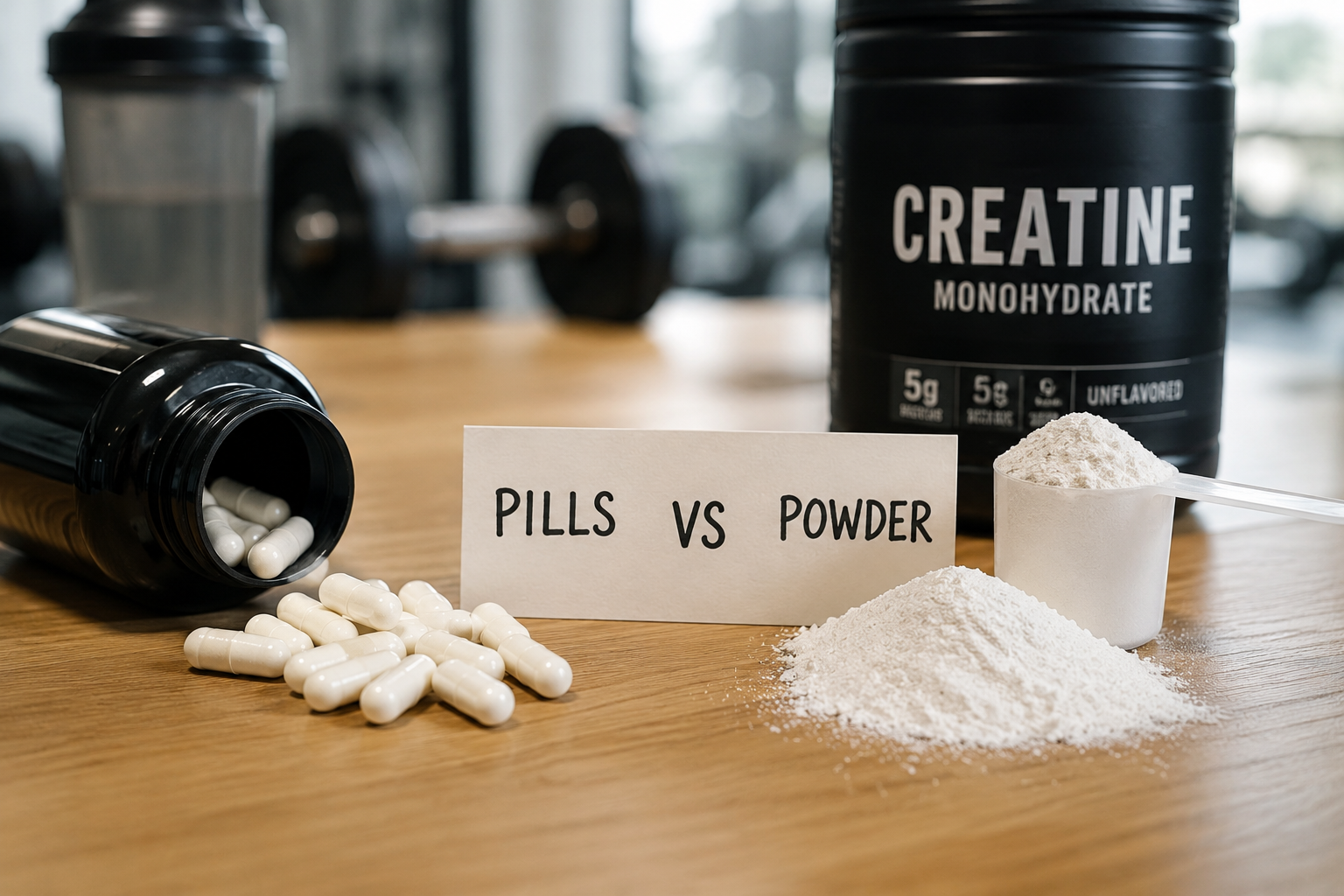
Choosing between creatine pills and powder often comes down to convenience, cost, and routine. Both formats can provide creatine monohydrate, the most studied form currently available. Research focuses more on total intake and consistency than delivery format alone. Therefore, effectiveness usually depends on consuming an appropriate amount regularly over time.
Powder and capsules mainly differ through serving format, preparation needs, and everyday convenience. Understanding these differences helps you choose a supplement form matching your regular routine.
- Creatine powder suits readers wanting adjustable servings and easy mixing with drinks.
- Creatine capsules suit readers prioritizing portability and avoiding powder texture or measuring.
- Neither format automatically becomes superior when the active ingredient and intake match.
Creatine monohydrate remains widely researched for strength and high-intensity exercise performance. However, choosing pills versus powder requires comparing dosage, ingredients, convenience, and personal preferences carefully.
Creatine Pills vs Powder at a Glance
Creatine pills and powder mainly differ in format, convenience, cost, and dosing flexibility. Both can contain creatine monohydrate, the most widely studied supplemental form available today. For most readers, consistency matters more than choosing capsules instead of powder.
| Comparison Factor | Creatine Powder | Creatine Pills or Capsules |
| Active ingredient | Often contains creatine monohydrate as the primary ingredient | Can contain the same creatine monohydrate active ingredient |
| Effectiveness | Depends largely on formulation and consistent intake | Depends largely on formulation and consistent intake |
| Serving flexibility | Powder allows easier adjustment using a measured scoop | Capsules provide fixed amounts based on individual product labels |
| Convenience | Requires measuring and usually mixing before consumption | Easier to carry without measuring or mixing powder |
| Portability | Larger containers may be less convenient while travelling | Capsules fit easily into compact supplement storage containers |
| Ingredients | Simple products may contain only creatine monohydrate | Capsules may contain shells and other formulation ingredients |
| Taste and texture | Requires drinking powder mixed into a chosen liquid | Avoids the taste and texture associated with mixed powder |
| Cost comparison | Cost should be compared using creatine provided per serving | Price depends on capsule strength, quantity, and creatine content |
Which Is Better: Creatine Pills or Powder?
The best choice depends on your routine, preferences, budget, and product label. Powder generally offers greater serving flexibility, while capsules focus more strongly on convenience. Neither format becomes automatically superior simply because creatine arrives inside another delivery form.
When comparing creatine pills vs powder, examine the actual creatine content first. Check ingredients, serving information, supplement form, and product quality before comparing convenience alone.
Are Creatine Pills as Effective as Powder?
Creatine pills can be as effective as powder when comparable creatine amounts are consumed. Research emphasizes consistent creatine intake and total dosage rather than delivery format alone. Creatine monohydrate remains the best-studied form for supporting high-intensity exercise performance across research studies. Accordingly, pill or powder format should not automatically determine expected supplementation results.
- Equivalent creatine amounts matter more than whether supplements are swallowed or mixed.
- Powder allows flexible measuring, while capsules provide fixed amounts per listed serving.
- Product labels should confirm creatine monohydrate content before comparing pills with powder.
- Consistent daily use influences muscle creatine stores more than delivery format differences.
What Actually Determines Creatine Effectiveness?
Effectiveness depends on whether enough creatine reaches muscles consistently across repeated supplementation. Regular intake gradually increases muscle creatine stores and supports phosphocreatine availability during exercise. That process supports rapid energy production during brief, repeated, high-intensity muscular efforts. Research also shows lower daily doses can increase intramuscular creatine over time.
Several practical factors influence how reliably someone maintains their intended creatine intake:
- Serving size: Each product provides a specific creatine amount per listed serving.
- Consistency: Regular intake matters when building and maintaining increased muscle creatine stores.
- Creatine form: Creatine monohydrate currently has the strongest overall supporting research evidence.
- Product quality: Reliable labeling helps confirm the amount and ingredient actually provided.
A major scientific review found creatine monohydrate retains substantial evidence supporting bioavailability and efficacy. Other marketed creatine forms have not consistently demonstrated superior effectiveness over monohydrate supplements.
Does the Pill or Powder Form Change the Results?
Available evidence supports creatine monohydrate itself, rather than a particular delivery format. This suggests pills and powder should perform similarly when equivalent amounts are consumed. Differences become more relevant when comparing serving size, ingredients, cost, and convenience. Therefore, powder is not automatically more effective simply because users mix it directly.
The meaningful differences usually involve how each supplement fits into everyday routines:
- Pills provide fixed amounts, making serving calculations dependent upon each product label.
- Powder offers adjustable measurements for users comparing different creatine serving amounts carefully.
- Capsules can include additional ingredients besides the primary creatine monohydrate active ingredient.
- Powder formulations may contain fewer ingredients, although individual product formulas still vary.
Ultimately, creatine pills effectiveness depends primarily on formulation and consistent creatine intake. The same principle applies when evaluating overall creatine powder effectiveness for supplementation.
What Is Creatine Powder?
Creatine powder is a powdered dietary supplement commonly containing creatine monohydrate as its active ingredient. Users typically measure each serving with a scoop before mixing it into liquid. Many products use simple formulas, although ingredients vary between brands and flavored versions. Checking the label confirms serving size, creatine amount, and any additional ingredients.
Creatine Powder Benefits
Creatine powder offers practical advantages for users who prefer flexible serving adjustments. Powder also makes comparing creatine content across products relatively straightforward for shoppers.
- A scoop can make measuring a labeled serving simple during regular routines.
- Unflavored products may contain fewer additional ingredients than some flavored formulas available.
- Powder can mix easily into water, shakes, or other suitable everyday beverages.
- Flexible measuring can help users compare different labeled serving amounts more precisely.
Creatine monohydrate also has extensive research supporting its use within sports nutrition. Evidence particularly supports supplementation for repeated, brief, high-intensity exercise and muscular performance.
Creatine Powder Drawbacks
Powder requires preparation, which may feel less convenient during travel or busy schedules. Texture and mixing preferences can also affect whether users enjoy taking powdered supplements.
- Users must measure servings carefully rather than relying on predetermined capsule amounts.
- Some powders may settle or leave texture when mixed with certain liquids.
- Large tubs can be less portable than capsules during travel or commuting.
- Flavored formulas may include sweeteners, flavorings, or other additional ingredients for taste.
Ultimately, creatine powder benefits center on flexibility, simplicity, and straightforward serving control. Its drawbacks mostly involve preparation, texture, storage, and portability preferences between users.
What Are Creatine Pills and Capsules?
Creatine pills and capsules package measured creatine amounts inside convenient swallowable supplement formats. Many products use creatine monohydrate, although formulations and serving sizes vary considerably. (ods.od.nih.gov) Supplement labels identify serving size, creatine quantity, and other listed ingredients clearly. (fda.gov)
Creatine Pill Benefits
Capsules can simplify routines for people who dislike measuring or mixing powders. Fixed capsule amounts also make each labeled serving easier to track consistently.
- Pills travel easily because they require no scoop, shaker, or mixing container.
- Capsules avoid powder texture, which some users may find unpleasant during consumption.
- Premeasured servings reduce guesswork when users follow the product label correctly and carefully.
- Small containers can be easier to carry during travel, work, or commuting.
These practical creatine pill benefits mainly relate to convenience rather than greater effectiveness. Creatine monohydrate remains the important active ingredient when comparing different supplement formats. (ods.od.nih.gov)
Creatine Pill Drawbacks
Creatine capsules can require several pills to provide a full labeled serving. That requirement may feel inconvenient for users who dislike swallowing multiple capsules.
- Capsule shells and binders may add ingredients beyond the primary creatine component. (fda.gov)
- Fixed amounts provide less flexibility when someone compares different labeled serving sizes.
- Per-gram costs can vary significantly, so bottle price alone can mislead shoppers.
- Users should compare creatine quantity per serving before judging overall product value.
Overall, creatine pills mainly offer portability, convenience, and predictable labeled serving amounts. The drawbacks involve capsule quantity, additional ingredients, cost, and limited serving flexibility. Checking the Supplement Facts panel helps users compare supplement products more accurately overall. (fda.gov)
Creatine Powder vs Capsules: Key Differences Explained
Creatine powder and capsules provide similar ingredients through different supplement delivery formats. The practical differences involve dosing flexibility, ingredients, convenience, cost, taste, and storage. Understanding each factor helps readers compare products without assuming one format works better.
- Effectiveness depends more strongly on creatine type, quantity, and consistent supplement intake.
- Powder offers flexible measuring, while capsules provide fixed quantities within each serving.
- Cost comparisons work better when shoppers calculate price against total creatine provided.
1. Effectiveness
Creatine effectiveness depends mainly on the ingredient, amount consumed, and consistent supplementation. Research supports creatine monohydrate as the most established form for exercise performance outcomes.
No evidence shows alternative creatine forms consistently outperform well-studied creatine monohydrate supplements. This evidence suggests delivery format should remain secondary when comparing equivalent monohydrate products.
2. Creatine Absorption
Creatine must enter circulation before muscles can increase their stored creatine concentrations effectively. Research has not established alternative marketed forms as superior sources of creatine monohydrate.
Therefore, faster dissolution should not automatically imply better long-term results from supplementation. Comparing total creatine provided remains more useful than focusing only on absorption speed.
3. Dosage Accuracy and Flexibility
Powder allows users to measure different serving amounts according to each product label. Capsules provide fixed quantities, so serving size depends on individual capsule strength.
- Several capsules may provide the amount contained within one labeled powder serving.
- Powder measurements offer greater flexibility when comparing different manufacturer serving recommendations carefully.
- Capsule users should check declared creatine amounts rather than comparing capsule numbers alone.
FDA guidance requires Supplement Facts panels to declare serving sizes and dietary ingredients. This information allows clearer comparisons between different creatine supplement formats and serving sizes.
4. Ingredients and Additives
Simple creatine powders may contain creatine monohydrate without numerous additional formulation ingredients. Capsules may include shell materials alongside ingredients required by particular product formulations.
However, ingredient lists vary considerably between brands, flavors, tablets, and capsule products. Supplement Facts panels identify dietary ingredients and declared quantities within each serving.
Checking labels helps identify:
- The active ingredient and specific creatine form listed within each supplement product.
- Any additional ingredients included alongside creatine within powders, capsules, or tablets.
- The creatine quantity provided through one complete manufacturer-defined serving of the product.
5. Cost Per Serving and Cost Per Gram
Bottle price alone cannot accurately show which creatine supplement provides better overall value. Instead, compare total creatine grams against the complete purchase price for each product.
Cost per gram provides a clearer comparison across different servings and package sizes. Research has found meaningful price differences among commercially available forms of creatine supplements.
A stronger value comparison should consider:
- Total creatine supplied across the entire container rather than container size alone.
- Creatine provided within each serving compared against the corresponding serving cost directly.
- Ingredient quality and testing alongside price before deciding which option offers value.
6. Convenience and Portability
Capsules provide strong portability because measuring, scooping, and mixing are usually unnecessary. Powder requires a container, measuring method, and suitable liquid for convenient preparation.
However, powder may fit easily into established home, gym, or shake routines. Convenience matters because practical formats can support more consistent everyday supplementation habits overall.
7. Taste and Mixing
Creatine powder requires mixing, making taste and texture relevant considerations for some users. Unflavored powder may still leave noticeable texture depending on liquid and preparation method.
Capsules avoid powder taste because users swallow creatine inside the capsule shell instead. Neither option is universally preferable because individual taste and swallowing preferences differ considerably.
8. Storage and Shelf Convenience
Powder containers generally require more space than small bottles containing capsules or tablets. Capsules can travel easily without carrying scoops, shaker bottles, or larger powder tubs.
- Powder should remain stored according to manufacturer directions printed on its packaging.
- Capsules offer compact storage for people regularly carrying supplements between different locations.
- Storage convenience becomes important when comparing supplement formats for frequent travel situations.
Overall, creatine powder vs capsules involves practical differences rather than completely different mechanisms. Ingredients, labeled serving amounts, cost, and convenience deserve greater attention during comparisons.
How Much Creatine Do Pills and Powder Provide?
Creatine pills and powder can provide similar daily amounts despite different serving formats. However, the actual creatine quantity depends entirely on each product’s Supplement Facts label. Powder products commonly list creatine in grams, while capsules may list smaller amounts. Therefore, comparing products requires checking total creatine provided within one complete labeled serving.
Research commonly discusses daily creatine intakes around three to five grams for supplementation. This range reflects studied protocols, not a personalized recommendation for every individual user.
- A powder serving may provide several grams through one measured scoop or portion.
- Capsules often provide smaller fixed amounts, requiring multiple capsules for equivalent total creatine.
- Always compare total creatine content rather than comparing scoop numbers against capsule counts.
- One gram equals 1,000 milligrams, making capsule-to-powder comparisons easier and more accurate.
For example, five 1,000-milligram capsules would provide five grams of total creatine. However, capsule strengths vary, so product labels should guide every serving comparison carefully. NIH maintains a database containing dietary supplement label information sold within United States markets.
When comparing creatine dosage between pills and powder, check these details carefully:
- Check the creatine form listed, preferably distinguishing monohydrate from alternative marketed forms.
- Confirm the amount of creatine provided per serving, not merely each individual capsule.
- Compare serving size because several capsules may constitute one manufacturer-defined complete serving.
- Review additional ingredients when comparing powder, tablet, and capsule supplement formulations carefully.
Ultimately, daily creatine intake depends on actual creatine quantity rather than delivery format. Research commonly references 3–5 grams per day within established supplementation protocols.
How Many Creatine Pills Equal One Scoop of Powder?
Creatine pill counts cannot be compared accurately without checking each product’s labeled amount. One scoop also varies because manufacturers define servings differently across individual powder products. The FDA requires supplement labels to show serving size and ingredient amounts per serving. Therefore, use label information rather than assuming one scoop equals several capsules.
To compare both formats correctly, convert every creatine amount into the same measurement unit. One gram equals 1,000 milligrams, making capsule and powder calculations easier to compare. Next, divide the powder serving’s creatine amount by each pill’s listed creatine amount. This calculation shows how many pills provide an equivalent labeled quantity of creatine.
Calculation:
Number of pills = Powder creatine amount ÷ Creatine amount per pill
For example, suppose one powder serving contains five grams of creatine monohydrate total. If each capsule contains 500 milligrams, ten capsules provide five grams altogether exactly. However, another product may contain different amounts within each individual pill or serving. That variation makes the Supplement Facts panel essential for accurate product comparisons.
When comparing a scoop with creatine pills, follow these label-based comparison steps:
- Check the creatine amount provided by one complete labeled powder serving first.
- Convert grams into milligrams whenever the capsule label uses milligrams instead of grams.
- Identify creatine provided by each capsule, not merely the total serving amount listed.
- Divide the powder amount by the amount supplied within one individual capsule.
- Confirm whether several capsules together represent one serving on the product label.
The key comparison involves total creatine content, not simply capsules versus scoops alone. Different products can provide different quantities despite using the same supplement form.
Creatine Loading: Does It Matter Whether You Use Pills or Powder?
Creatine loading uses a higher initial intake to increase muscle stores more quickly. Research commonly describes loading with 20 grams daily for five to seven days. After loading, studies often use smaller daily amounts to maintain elevated stores. However, creatine loading is optional because lower daily intake also increases stores gradually.
What Is a Creatine Loading Phase?
A loading phase usually divides the total daily amount across several smaller servings. The NIH describes 20 grams daily, divided into four five-gram portions, for adults. This approach raises muscle creatine stores faster than starting with smaller daily amounts. Afterward, research protocols commonly continue with three to five grams each day.
- Twenty grams daily represents a research loading protocol, not universal personal guidance.
- A seven-day loading phase represents one commonly studied approach within adult research.
- Loading primarily changes how quickly muscle creatine stores reach higher concentrations initially.
- It does not make creatine fundamentally different or permanently improve its effectiveness.
Is Creatine Loading Necessary?
People following lower daily amounts can reach similar muscle creatine levels later. Research indicates three grams daily for several weeks can increase stores gradually. Lower daily creatine intake can increase stores without using an initial loading phase. A loading strategy mainly shortens the time needed to increase muscle stores.
Research commonly follows loading with a smaller maintenance intake after stores increase. The NIH describes maintenance protocols using three to five grams daily afterward. A loading phase is not required for creatine stores to increase eventually. Lower daily intakes simply require more time to produce comparable muscle saturation.
Pills vs Powder During a Loading Phase
Powder can make larger loading amounts easier to measure across multiple servings. Capsules may require several individual pills to reach the same total amount. Therefore, practical convenience depends strongly on the creatine quantity provided per capsule. Always compare the Supplement Facts label before comparing loading convenience between formats.
- Powder may reduce the number of separate units needed during loading periods.
- Capsules can remain convenient when portability matters more than the capsule count.
- Neither format changes the underlying purpose of increasing total muscle creatine stores.
- The meaningful difference remains how easily each format delivers the intended amount.
Is Creatine Monohydrate Better in Powder or Pill Form?
Creatine monohydrate is not inherently better as powder simply because of delivery format. Capsules can contain the same researched ingredient, provided the labeled creatine amount matches. Research supports creatine monohydrate more strongly than alternative marketed creatine forms overall. Therefore, shoppers should separate creatine type from the format used for consumption.
- Powder and pills can both provide creatine monohydrate as their active ingredient.
- Powder usually offers flexible measuring, while pills provide predetermined labeled serving amounts.
- Alternative creatine forms have not consistently demonstrated superior outcomes over creatine monohydrate.
- The strongest comparison should examine ingredient quality, dosage, convenience, and total creatine.
Creatine Form vs Supplement Format
Creatine form describes the chemical version listed as the supplement’s active ingredient. Supplement format describes whether that ingredient appears as powder, capsules, or tablets. Those concepts matter because product format alone does not establish greater effectiveness. Evidence continues supporting monohydrate as the benchmark form for creatine supplementation research.
For evidence-based comparisons, creatine monohydrate remains the best-supported creatine form currently available. Other marketed forms have not consistently shown meaningful advantages over standard monohydrate supplementation.
If two products provide comparable creatine monohydrate amounts, format becomes mainly practical. Powder may suit flexible measuring, while capsules may suit portable daily routines. Neither option should be considered universally superior without comparing actual product labels.
Creatine Pills vs Powder for Muscle, Strength and Workouts
Creatine supplementation is widely studied for supporting repeated high-intensity exercise performance. The strongest evidence involves creatine monohydrate rather than a specific supplement delivery format.
Whether you choose pills or powder, the active ingredient remains especially important. The delivery format does not automatically determine muscle or workout results.
Creatine for Strength and High-Intensity Exercise
Creatine helps increase muscle creatine availability, supporting rapid energy production during intense exercise. This can benefit activities involving repeated short bursts of muscular effort.
- Resistance training can involve repeated high-intensity efforts requiring rapid energy availability.
- Sprinting and similar activities can also place substantial demands on phosphocreatine energy systems.
- Consistent supplementation can increase muscle creatine stores over time.
- Individual responses may vary depending on diet, training, and baseline creatine stores.
Creatine for Maintaining or Building Muscle
Creatine is commonly used alongside resistance training programs focused on strength and muscle development. Research suggests supplementation can support training performance and lean mass outcomes when combined with exercise.
However, creatine should not be viewed as a replacement for progressive training. Adequate nutrition, recovery, sleep, and consistent exercise remain important factors.
Does Powder Build More Muscle Than Pills?
There is no established reason to expect powder automatically produces greater muscle gains. The important comparison involves the creatine form, amount consumed, and consistency of supplementation.
- Powder may be easier for users who prefer flexible serving measurements.
- Pills may suit people who prioritize portability and simpler supplement routines.
- Both formats can provide creatine monohydrate when products contain that ingredient.
- Product quality and accurate labeling remain important when comparing different supplements.
For creatine for muscle growth, the format should therefore receive less attention than the underlying ingredient. A convenient format may still be valuable when it helps someone maintain a consistent routine.
Creatine Pills vs Powder: Which Is Better for You?
Choosing between creatine pills and powder depends largely on your preferences and routine. Both formats can provide creatine monohydrate when products contain equivalent active ingredient amounts.
Your preferred supplement form should support consistent use without creating unnecessary inconvenience. Consider cost, portability, serving flexibility, ingredients, and personal preferences before deciding.
Choose Creatine Powder If…
Powder may suit people who value flexible measuring and straightforward daily preparation. It can also provide better value when comparing total creatine against product prices.
- Powder works well for users comfortable measuring servings with a scoop.
- It suits people who regularly mix supplements into water or shakes.
- Powder can simplify larger serving amounts compared with swallowing multiple capsules.
- It may appeal to shoppers prioritizing simple formulations and lower cost per gram.
Choose Creatine Pills If…
Capsules may suit people who prioritize portability and quick supplement preparation. They eliminate mixing, measuring, and carrying larger containers during everyday activities.
- Pills work well for people frequently travelling, commuting, or visiting different gyms.
- Capsules suit users who dislike powder texture, taste, or preparation requirements.
- Fixed serving amounts can simplify routines when following product label directions carefully.
- They may provide greater convenience for people maintaining supplements outside their homes.
Can You Switch Between Pills and Powder?
You can compare different creatine formats by checking their actual creatine content. Switching formats does not require treating pills and powder as entirely different supplements. The important comparison involves the active ingredient, labeled amount, and product formulation.
When switching between formats, compare these details:
- Confirm whether both products contain creatine monohydrate as their active ingredient.
- Check the total creatine amount provided within each complete labeled serving.
- Calculate the cost per gram instead of comparing containers using retail prices.
- Review additional ingredients before choosing a different capsule or powder formulation.
Ultimately, the best creatine supplement is one that fits your routine consistently. Powder may prioritize flexibility and value, while pills emphasize portability and convenience.
- travel easily between home, work, school, and fitness facilities.
- Serving size: Several capsules might be needed to provide a complete creatine serving.
- Cost: Compare total creatine grams rather than comparing containers using retail prices.
- Ingredients: Check capsule shells and other additional ingredients listed within the product.
- Flexibility: Fixed capsule amounts provide less serving adjustment than measured powder.
For some users, paying more provides worthwhile convenience during demanding schedules. For others, powder may offer better value and simpler ingredient comparisons.
When Are Creatine Capsules Worth Choosing?
Capsules may make sense when preparation creates unnecessary friction within your daily routine. A convenient supplement format can encourage consistency when powder preparation becomes inconvenient.
They can particularly suit people who:
- Travel regularly and want compact supplement storage without carrying larger containers.
- Dislike mixing powdered supplements because of taste, texture, or preparation requirements.
- Prefer predetermined servings instead of measuring powder with a scoop each time.
- Value convenience enough to accept potentially higher costs per gram of creatine.
Ultimately, are creatine capsules worth it depends on your priorities and product selection. If convenience improves consistency, capsules may justify their additional cost for some users. If price and flexible serving sizes matter most, creatine powder may provide greater practical value.
How to Choose a Creatine Supplement
Choosing a creatine supplement involves more than comparing powder against capsules. Product quality, creatine content, ingredients, testing, and cost all deserve careful consideration. A clear label also makes comparisons between different supplement formats much easier.
Check the Creatine Form
Creatine monohydrate has the strongest research foundation among commonly marketed creatine forms. Research has not consistently shown newer forms to outperform standard creatine monohydrate.
For most comparison purposes, check whether the product clearly identifies creatine monohydrate. Avoid assuming unfamiliar creatine forms automatically provide better results.
Check Creatine Per Serving
Always check how much creatine each complete serving actually provides. Capsule counts alone cannot tell you the total creatine contained within each serving.
- Check the listed serving size before comparing two different products.
- Compare grams of creatine rather than comparing scoops, tablets, or capsules.
- Confirm whether the listed amount applies to one capsule or multiple capsules.
- Remember that different manufacturers can define serving sizes differently.
Check the Full Ingredient List
The active ingredient represents only part of a supplement’s complete formulation. Capsules can contain shell materials, while flavored powders may contain additional ingredients for taste or texture.
Review the label for:
- Creatine form and declared amount within the Supplement Facts panel.
- Additional ingredients included alongside the primary creatine ingredient.
- Sweeteners, flavors, colors, or other formulation ingredients where applicable.
- Any ingredient you personally need to avoid because of dietary preferences.
The FDA provides guidance explaining how dietary supplement labels present serving information and ingredients.
Look for Independent Quality Testing
Independent testing can provide additional confidence about supplement identity and quality. However, testing claims should be verified rather than accepted solely from product marketing.
Look for reputable third-party certification or testing information when available. Independent quality programs can evaluate whether products meet specific identity, purity, or manufacturing standards.
Calculate Cost Per Gram
Cost per gram provides a more meaningful comparison than bottle price alone. This calculation works particularly well when comparing capsules against powdered creatine.
Use this simple formula:
Cost per gram = Product price ÷ Total grams of creatine
For example, a larger container may cost more initially but provide substantially more creatine overall. Comparing total creatine helps reveal the actual value behind different package sizes.
Ultimately, the best creatine supplement should combine an evidence-supported creatine form, clear labeling, suitable ingredients, reliable quality, and reasonable value. Convenience should then determine whether powder or pills fit your routine better.
Creatine Pills vs Powder: Final Verdict
Creatine pills and powder can both provide effective creatine supplementation when labels show comparable amounts. The biggest differences involve convenience, cost, portability, ingredients, and serving flexibility.
Creatine monohydrate remains the most established form for supplementation research. Therefore, choosing between pills and powder should begin with the ingredient rather than delivery format.
| Best For | Recommended Format |
| Lowest cost per gram | Powder |
| Flexible serving measurements | Powder |
| Easy mixing with beverages | Powder |
| Portability | Pills or capsules |
| Avoiding powder texture | Pills or capsules |
| Minimal preparation | Pills or capsules |
| Larger serving amounts | Powder |
| Predetermined serving amounts | Pills or capsules |
For many users, creatine powder offers better value and flexible serving control. Capsules can become the more practical choice when portability and convenience matter most.
The best choice is ultimately the format you can use consistently. A convenient supplement that fits your routine may be more useful than choosing solely based on price.
When comparing creatine pills vs powder, focus on creatine content, formulation, quality, cost, and personal preferences. Neither format deserves to be considered universally superior without examining the actual product label.
e effective than equivalent creatine capsules. Powder mainly provides advantages involving flexible measurements, mixing, and potentially lower costs. Your actual product label matters more than delivery format.
How many creatine pills equal 5g of powder?
The answer depends entirely on each capsule’s listed creatine content. For example, ten 500-milligram capsules provide five grams of total creatine. Always calculate using the Supplement Facts panel for accurate product comparisons.
Does creatine come in pill form?
Yes, creatine is available as capsules and tablets alongside powdered supplements. The NIH recognizes capsules, tablets, liquids, and powders among available supplement formats.
Is creatine absorbed faster as a powder?
Powder dissolves before absorption, while capsules must first release their contents. However, faster dissolution does not automatically mean better long-term supplementation outcomes. Comparing total creatine intake remains more useful for practical product decisions.
Can I take creatine pills every day?
Research commonly examines creatine supplementation across daily routines lasting several weeks or longer. Healthy adults have generally tolerated creatine supplementation well in studied protocols. People with medical conditions should discuss supplements with qualified healthcare professionals.
Is 3g or 5g of creatine better?
Both amounts appear within studied creatine supplementation protocols for adults. Research also supports lower daily intake without requiring an initial loading phase. Individual circumstances can influence which approach is appropriate.
Do I need a creatine loading phase?
A loading phase is not required for gradually increasing muscle creatine stores. Research describes both loading protocols and lower daily approaches without loading. Loading mainly increases muscle creatine stores more quickly initially.
Can I switch from creatine powder to capsules?
Switching formats is generally a matter of comparing actual creatine amounts. Check the creatine form, serving size, and amount provided by each product. This comparison prevents accidentally treating different capsule strengths as equivalent servings.